

We were stabbing steel columns up through an existing roof line on a project a few weeks ago. Simple enough concept. The drawing package we were using as our baseline showed the column coming up through the roof line by nine inches. Before we cut a single column to length, I asked the general contractor to verify the actual roof elevation against the design. I wanted a field check before we committed steel to a saw. They opted not to do it.
I did not agree with that decision, but it was theirs to make and I moved on.
Then the column went up. It was flush with the existing roof line. Not nine inches proud. Flush.
I want to be honest about what happened in my head in that moment, because I think most people in this industry know the feeling. I got flustered. I felt my blood pressure climb before I even understood the problem. My first thought was not "what happened here." My first thought was "why didn't they measure like I asked them to." I started placing blame before I had a single fact to support it. I even said something to their project manager about their onsite guy not verifying the roof line like I had requested. I was building a case in my head, and I was building it fast, and I was building it on nothing.
It took me about a minute to catch myself. That minute felt long in the moment, but looking back, it was the fastest and cheapest correction I made all day. I stopped talking and started digging into the drawings instead.
A few hours and a lot of measurements later, the real answer showed up. It was not a bad column length. It was not a missed field verification. The design detail we were using as our baseline was drawn for a different building in the package, not the one we were standing in. The top of steel elevations were different between the two buildings, which meant the distance between the roof line and the top of steel was different too. The column was right. The cut was right. The drawing reference was wrong.
I had already told someone their team failed to do something, based on an assumption that turned out to be false. That is a hard thing to sit with. I pride myself on being right, on knowing my drawings, on being the guy who catches the problem before it becomes expensive. And here I was, the one who needed to be corrected, by myself, a few hours after opening my mouth.
Here is what I have learned from moments like this one, and I have had more of them than I would like to admit. Jumping to conclusions is not really a communication problem. It is a patience problem wearing a communication costume. When something does not match what we expect, the brain wants an answer immediately, and it will hand you the fastest one available, which is almost always the one that protects your own position first. Someone else did not do their job. Someone else measured wrong. Someone else missed it. That story feels good for about ninety seconds. Then the facts show up and the story falls apart, and now you have to clean up two messes instead of one. The original problem, and the accusation you made before you understood it.
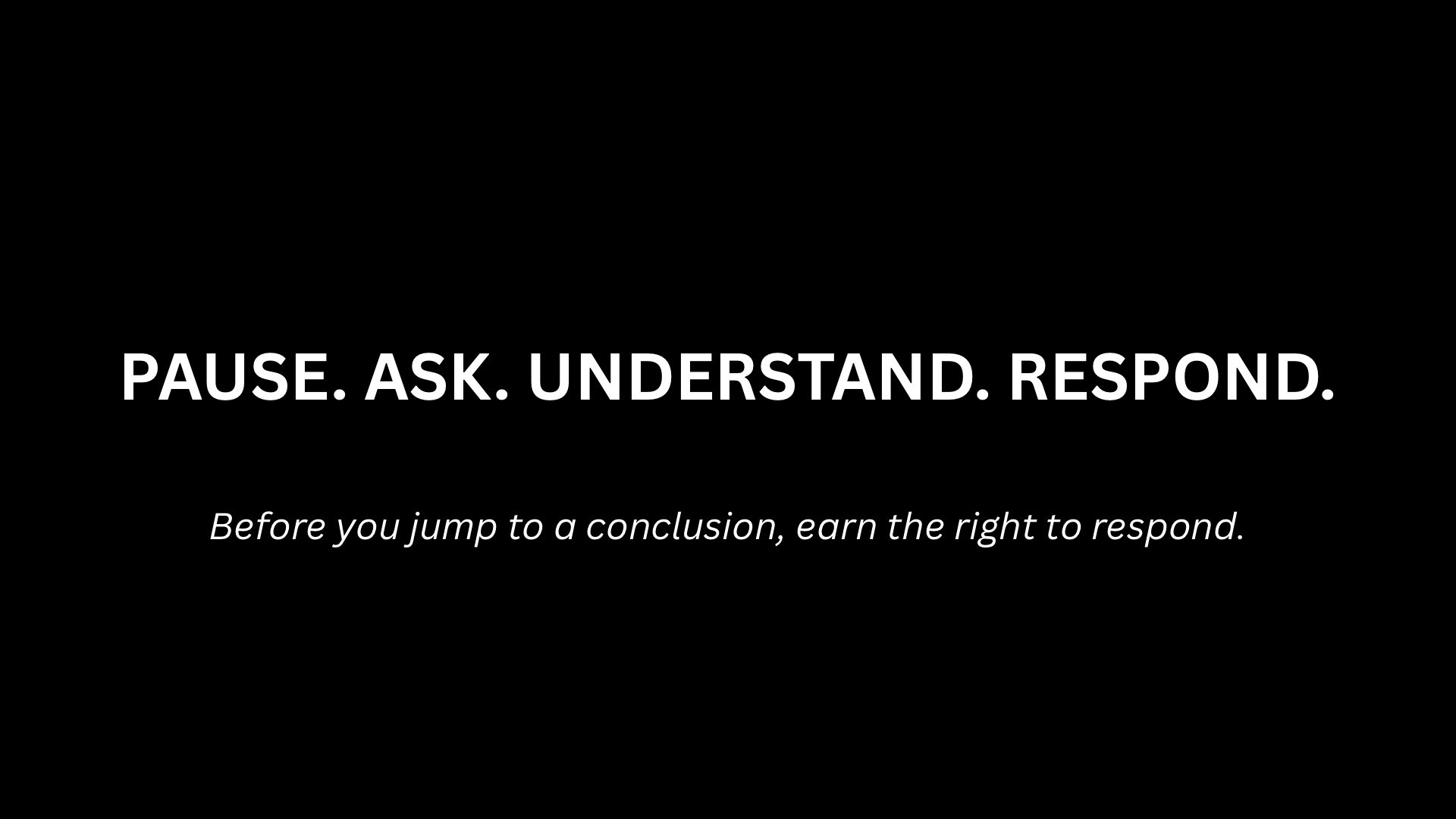
So I built a process for myself. Not a poster on the wall, a real one I actually run through when something does not add up in the field. I call it Pause, Ask, Understand, Respond.
Pause.
The moment something contradicts what I expected, I make myself stop talking. Not stop thinking, stop talking. My rule is that I am not allowed to assign blame or cause out loud until I have moved through the rest of the process. This sounds simple. It is not. The urge to say something in the moment is strong, especially when you feel caught off guard in front of other people. But a sentence said in the first ninety seconds cannot be unsaid, even if you are wrong five minutes later. The pause is not hesitation. It is the thing that buys you the right to be accurate instead of just fast.
Ask.
This is the step I used to skip entirely. I would go straight from surprise to conclusion, with no stop in between to actually gather information from the people closest to the problem. Stephen Covey wrote about seeking first to understand before seeking to be understood, and that idea has stuck with me because it flips the natural order. Most of us listen just long enough to build our response. We are not really listening, we are reloading. Asking real questions means going in with the goal of understanding, not the goal of confirming what you already suspect. A few questions I have started using on purpose in the field:
- Can you tell me more about what you saw or measured?
- What led to this? Walk me through it.
- Help me understand how this was decided.
None of those questions assign fault. All of them buy you real information instead of a story you built yourself under stress.
Understand.
This is where I separate facts from stories, which has become the most useful mental habit I have built out of all of this. A fact is a number, a measurement, a date, something written on a drawing. A story is the meaning I attach to that fact, usually within about three seconds, usually without evidence. The fact in my situation was that the column was flush with the roof line instead of nine inches proud. The story I told myself instantly was that the GC's onsite guy failed to verify the roof elevation like I had asked. That story felt true. It was not a fact. It was a guess wearing a fact's clothing. The actual fact, once I dug into it, was that the drawing detail we were referencing belonged to a different building in the package. Separating those two things, what actually happened versus what I assumed happened, is the entire skill. Most conflict on a jobsite is not a disagreement about facts. It is two people defending two different stories, each one convinced theirs is the fact.
Respond.
Only after pausing, asking, and actually understanding do I say anything with authority. And if I already said something wrong before I got there, which I did, this step includes going back and correcting it directly with the same person I said it to. Not a vague acknowledgment days later. A direct correction. I told their PM I was wrong about the field verification comment, that the real issue was a drawing reference error on our end, not a missed measurement on theirs. It is uncomfortable to walk that back. It is far more uncomfortable to let a false accusation sit unspoken between two people who still have to work together for months.
There is one more piece underneath all of this that I am still working on, and I think it might be the hardest one. I have to get comfortable not knowing the answer right away. My instinct is to resolve uncertainty as fast as possible, because uncertainty feels like exposure, like I am standing in front of people without an answer in my hand. But the fastest answer is usually the least accurate one. Sitting in the discomfort of "I do not know yet, let me find out" is not weakness. It is the only honest position to hold before the facts are actually in front of you. I am learning to let that discomfort sit for a few hours instead of resolving it in the first few seconds with a guess dressed up as certainty.
I do not think I will ever fully stop having that first flash of frustration when something in the field does not match the plan. I am not sure that is even something to aim for. But the gap between the flash and the sentence that comes out of my mouth, that gap is trainable. That is the part I am actually working on. Not eliminating the instinct, just refusing to act on it until I have earned the right to.
I do not know everything. I do not have all the information most of the time, especially in the first sixty seconds after a surprise. None of us do. The people who are good at this are not the ones who never feel the urge to jump. They are the ones who have built a habit strong enough to pause, ask, and understand before a single word leaves their mouth.
Your four tips- Pause, Ask, Understand, Respond, are important not only for work-related issues but also for life in general. Some of the Asian cultures, Japan for instance, excel in this regard.