

I got a text the other day from a homeowner I did a project for a few years back. He sends these every few months — no real reason, just an update on his life that happens to involve something we built together. This time it was a photo of him backing his truck into his garage, lowering his kayaks down out of the storage tray above, and loading them onto the roof rack.
He was thrilled. And honestly? So was I.
That text is exactly why I do this work.
The Project
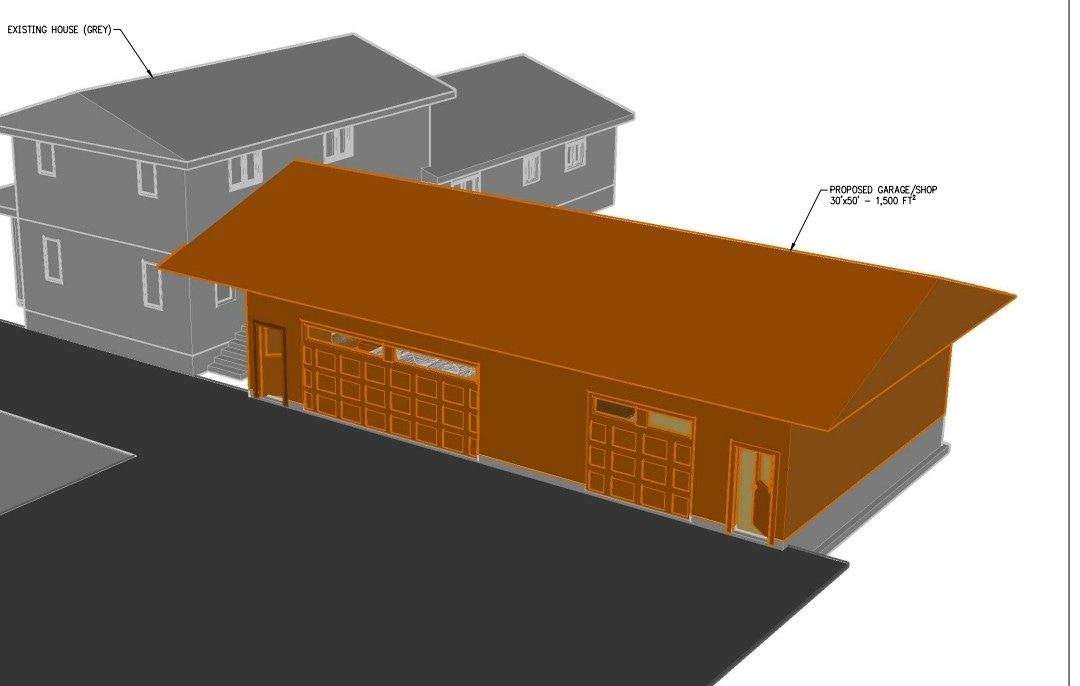
A few years ago, I built a 1,500 square foot, three-car garage addition onto an existing house, enclosing the old porch area in the process. We modeled the entire thing in 3D AutoCAD before a single footing went in the ground, and we spent real time on the front end — walking through every detail together, all the way down to paint colors and roofing material.
The owner was part of the design from day one. My role was to guide him through the decisions: here's what this costs, here's what it gets you, here's the tradeoff. That kind of collaboration is where the good stuff happens.
A few of the choices we made didn't add much cost but added a disproportionate amount of value:
Oversized 9'x18' garage doors — practical, but also just a more impressive presence for the space
Trey ceilings — small architectural upgrade, big visual payoff
Extensive electrical circuits — built for how he'd actually use the space, not just the minimum code
Belt-drive garage door openers with built-in cameras — quieter operation, plus the ability to monitor the garage remotely
A metal roof, cut in cleanly under the existing house windows, instead of the cheaper standard option
None of these were the cheapest path. Altogether, they probably added 10–15% to the project cost. But that 10–15% is the difference between a garage that functions and a garage the owner is still texting me about, unprompted, years later — happy, enthusiastic, genuinely satisfied.
Why This Matters More Than the Garage
Here's the thing — this project happened to be residential, but most of my work has actually been industrial, specifically in food manufacturing. And the lesson is identical: projects are about value, not just completion.
A project that gets finished on time and on budget but doesn't deliver real value isn't actually a success. It just looks like one on paper. Those are two very different outcomes, and the gap between them is where most of the real risk in project work actually lives.
Where Value Gets Lost
I've seen this play out too many times in the industrial world. A business case gets written, value gets projected — sometimes accurately, sometimes not — capital gets approved, and the asset gets installed. And then one of a few things happens:
The business changes. A line gets built to run a specific product at a specific volume, and eighteen months later the product mix shifts, a customer contract ends, or the company pivots strategy. The asset still works perfectly. It's just no longer pointed at the right problem.
The original assumption was wrong from the start. Maybe the volume projections were optimistic. Maybe the business case leaned on a sales forecast that never materialized. Maybe nobody stress-tested the assumption hard enough before the capital was approved, because the project had momentum and nobody wanted to be the one to slow it down.
Or the value was real, but it never got fully captured. The equipment goes in, it runs, but the operational changes needed to actually realize the projected savings — staffing adjustments, process changes, training — never happen. So you've got a capable asset being run in a way that leaves most of its value on the table.
Any one of these results in the same thing: a piece of capitalized equipment sitting on the floor, partially used or not used at all. That's not a hypothetical. That happens more than most people in this field want to admit, and it's rarely because anyone did anything wrong on purpose. It's usually a slow drift — a good plan meeting a business reality that moved faster than the project did.
What Good Value Capture Actually Looks Like
The garage project worked for a simple reason: the value case was clear from the beginning, and every decision — even the more expensive ones — was made in service of that value, not in spite of it. The owner wasn't paying for upgrades for the sake of upgrades. He was paying for a space that would actually work the way he needed it to, for years, in ways he could feel every time he used it.
I try to carry that same discipline into industrial work, even though the stakes and the scale are completely different. Before a project gets capital approved, the questions worth asking are the same ones we walked through in that garage design: What does this actually need to do? What's the real cost of getting it slightly wrong? Where is the value actually going to come from, specifically, and who is accountable for making sure it shows up once the equipment is running?
That last one matters more than people give it credit for. A business case isn't a one-time document you write to get approval and then file away. The value has to be tracked after startup, not just projected before it. Otherwise you find out two years later — the hard way — that the case never materialized, and nobody noticed until someone went looking.
The Standard
That's the standard I try to hold every project to, whether it's a homeowner's garage or a processing line running food product. Did this actually deliver what we said it would? Is someone genuinely better off because this got built? Is the asset doing what it was capitalized to do, or has the business quietly moved on without anyone updating the plan?
When the answer is yes, you get a text message with a photo of kayaks coming down out of a garage ceiling, from someone who didn't have to send it.
That's the whole job, right there.